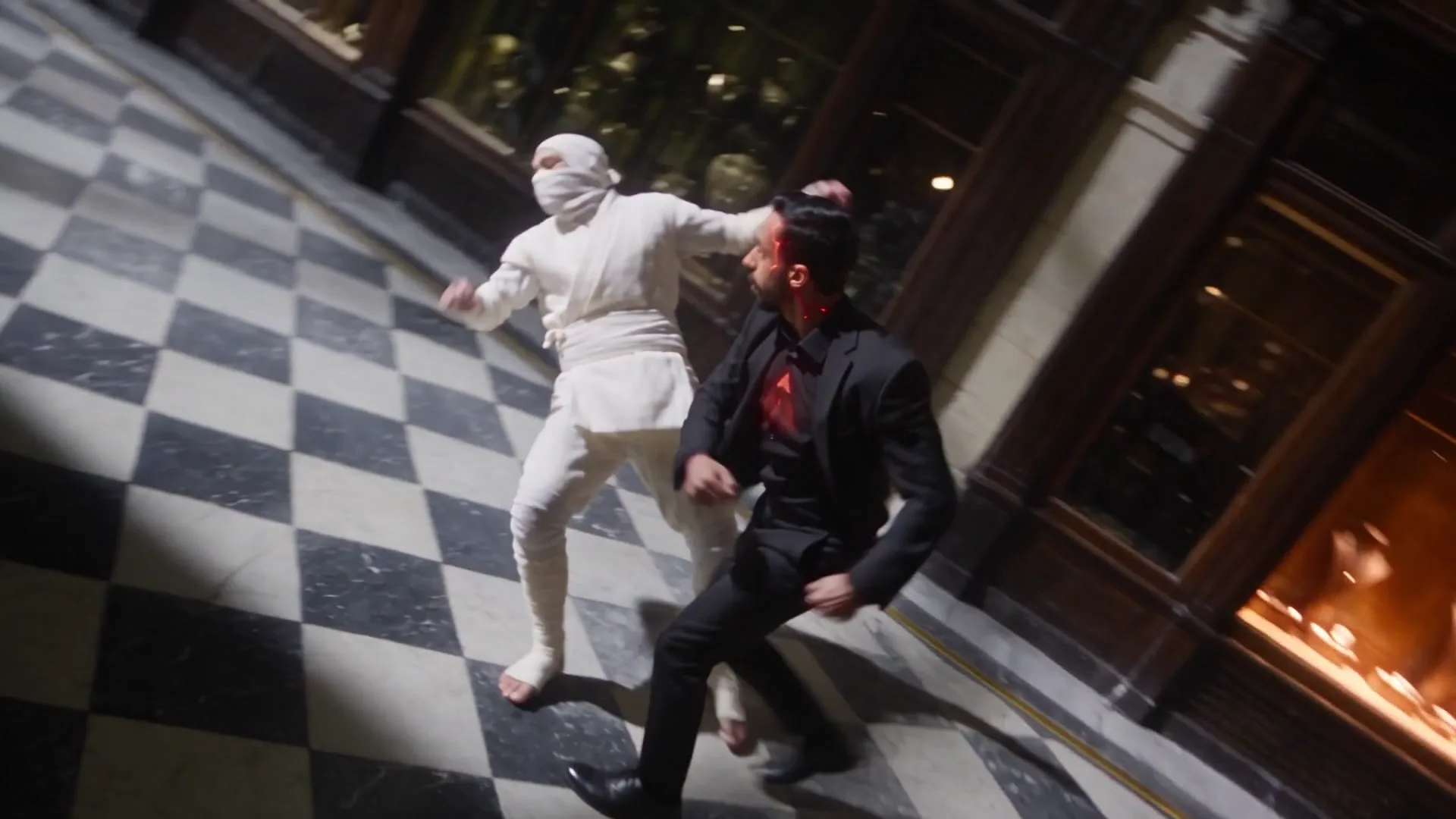
Running time35 seconds
Takeone take, zero cuts
One-take · night · covered set
THE EMBER — Paris Passage, One Take
What it took
- One single take, zero cuts
- Previsualised in 3D before the first image
- Frame-by-frame control
The studio's demonstration: thirty-five seconds on screen, one single take, zero cuts. Behind it, six production posts, seven cast characters, and days of work.
A man in a black suit walks down a covered Parisian passage at night. Six white-clad opponents come at him, one at a time — and no two are alike: each one was cast, dressed, injured, approved.
The sixth pulls his covering down: he wears the hero's own face, smoother, ten years earlier. The founder of the firm plays against himself, inside the same take, with no cut to hide the join.
The mountain emblem glows like an ember under his shirt, and the carving above the carriage door wakes as he walks out. That emblem is ours: the workshop's signature at the foot of the canvas.
One camera, from the first frame to the last. Nothing is rescued in the edit: in a long take everything is decided beforehand, and a mistake at the thirty-fourth second is paid for by redoing the whole shot.
Set as volumes, camera path, distances, pacing: all set second by second in previsualisation, as on a high-end set. A long take is never improvised — it is calculated.
The hero is real: the founder, filmed to hold his face. The six opponents were cast one by one — silhouette, gait, wardrobe, state of injury — then validated in motion, never on a still, before entering the shot. Nothing is left to chance: everything is chosen, then precomputed.
The sixth opponent uncovers his face and wears the hero's own features, smoother. The founder plays against himself: two ages of one man, held frame by frame, inside a take that never cuts.
Moonlight through the glass roof, two sconces, the shop windows: no source that does not exist in frame. Organic grain, anamorphic optics, a palette held from the first frame to the last.
Nothing ships without a frame-by-frame review: one finger, one eyeline, one lighting mismatch is enough to have a shot redone. Redone, not patched over — it takes longer, and it is the only way to hold this standard.
After one exceptional piece, a catalogue. Three products invented here — a burger, an iced tea, vitamin gummies — each with its own identity, voice and pace. Two are watched, the third is acted. Nothing was subcontracted: the name, the packaging, the label copy, the film and the voice all come from the same house.
These three products do not exist. The name, the packaging, the label copy, the identity, the film and the voice were all designed and made here, end to end.
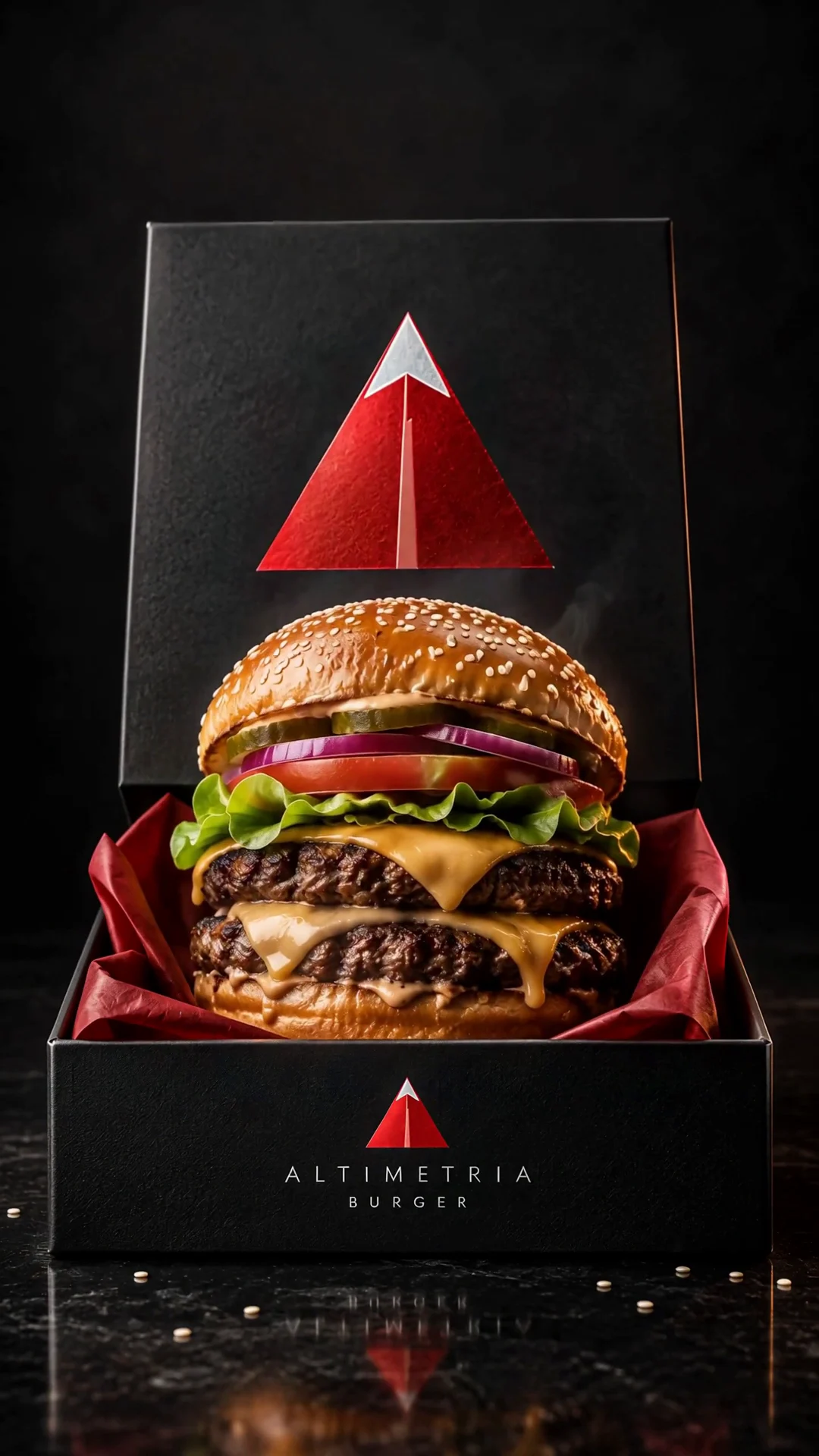
Premium food service. Black kraft box, black-and-cream identity, red accent: the packaging, the name and the label copy were all drawn for this film.

Glass bottle, light ground, green ink. The only one of the three on a light ground: same house, different world — which is exactly what a catalogue must prove.

Five flavours, vegan, sugar-free, twelve vitamins: the entire product sheet was written here. And it is the only one of the three that is acted — a couple discovers the product and talks about it.
We produce four families of films, and they do not resemble one another: not the breakdown, not the casting, not the lighting, not the edit. Before writing a single line, we ask one question, and the answer governs everything else — pace, tone, length, down to the decision not to put a single word on screen.
“Who watches it, and what do they buy right after?”
What kills it — Talking about ourselves.
What kills it — Explaining, justifying, quantifying.
What kills it — Visual bluster.
What kills it — Cinema.
A film that tries to serve two audiences serves neither. That is why we sometimes decline to add “just one line about the company” at the end of a demonstration film.
A long take is not obtained by pressing a button, nor by rerunning a machine until it lands right. It is obtained by deciding everything beforehand, producing every shot with the same crew, and verifying everything afterwards. Here is the order, exactly as we hold it on every film — and it is counted in days, not minutes.
The script, then the technical breakdown: every shot timed, every camera move described, every cut decided. What is not settled here costs ten times more later.
Set as volumes, characters as silhouettes, animated camera: the path, the distances and the pacing are set where correcting still costs nothing.
Every character is chosen — face, silhouette, gait, wardrobe, state of injury — then validated in motion, never on a still. Sets, props, palette, light sources: a production bible written once and reread on every shot by the whole crew.
Live-action photography when the scene demands it, synthetic imagery when it allows it, visual effects and compositing in every case. The choice is technical, it is made at the breakdown, never at the last minute.
A continuity supervisor holds whatever must stay identical from shot to shot; then one person whose only job this is walks every shot in slow motion — hands, eyelines, textures, matches. A shot that is not right is redone, not patched over.
The film is edited, graded and mixed; then the formats are cut from the master — wide, vertical, square, six seconds — reframed by hand, never stretched.
What you see on screen fits in thirty-five seconds. What it took to get there fits in six production posts — the same as on a set, held by people whose only trade this is, with the equipment and the investment that this standard demands. Here is what each post demands, what the crew does there, and what we tell you before the quote.
| The post | What it demands | What the crew does | What we tell you upfront |
|---|---|---|---|
| Direction and breakdown | A director, an art director, a cinematographer: the film is decided shot by shot, on paper, before a single image exists. | Script, timed technical breakdown, storyboard, 3D previsualisation of every camera move. | A shot not settled here is not rescued in finishing. We produce nothing without a validated breakdown. |
| Casting, characters and sets | Casting, auditions, wardrobe, location scouting or set building, props: the longest post of all pre-production, and the one that decides credibility. | Every character is cast then validated in motion, never on a still: silhouette, gait, wardrobe, state of injury. Sets are filmed, rebuilt or entirely built in 3D, as the scene demands — never the other way round. | A real face enters a film only with written consent. No exception, whatever the deadline. |
| Photography and synthetic imagery | A set, lighting, lenses, and the moves impossible by hand: crane, cable, drone — or a virtual camera set to the millimetre. | Sometimes we shoot, sometimes the scene is built entirely in the studio: the choice is technical and is made at the breakdown, according to what the scene requires. | That choice is stated before the quote, with what it allows and what it rules out. It does not change mid-production. |
| Visual effects and finishing | The heaviest post of any production: integration, matched light, textures, simulation, rendering — frame by frame. | Compositing, rotoscoping, relighting, set extension, clean-up, stabilisation: every shot goes through finishing before it reaches the edit. | A shot that is not right is redone, not patched over. It takes longer, and it is the only way to hold a long take. |
| Titles, figures, on-screen text | A graphic designer, a motion designer, typography set to the pixel. | Everything written on screen is composed in code, on our own tools, then laid over the image: crisp at any size, exact, editable within the hour. | Every figure displayed is checked against its source before delivery. One wrong figure means the film is redone. |
| Sound, grading and delivery | Music, sound effects, mixing, grading, conforming, versions per format and per platform. | Original music from a brief, sound design, voice when needed; the grading of the master, then the formats cut from it. | We promise a delivery, a quality and a deadline. Never an audience. |
You do not receive a file.
A studio film is delivered with its versions, its rights, its schedule and one point of contact. Here is what arrives at your end, and what stays with us for what comes next.
The film at full quality, graded and mixed, then the formats cut from the master: wide, vertical, square, six seconds — each reframed by hand, never stretched.
Breakdown, previsualisation, first cut, graded film: four stages, four looks from you. Nothing moves forward without your written approval.
Music, voices, faces, sets: every element comes with its usage rights, per medium and per duration. You know where you may broadcast it.
Production days are stated in the quote, post by post. A date that moves is announced the day it moves, not at delivery.
Cast characters, sets, palette, lights, continuity sheets: everything that made the film stays archived with us. A sequel, a variation, a second season starts from there — and the character is already yours.
One person follows your film, knows your constraints and answers. No platform, no ticket.
The studio works for companies in every sector — a restaurant, a developer, a clinic, a software publisher — with the same crew and the same standard as on the film you have just watched.
A scene is judged on its slate as much as on its image: how long it runs, in how many takes it holds, and what had to be settled before the camera rolled. Here is one, with the three things that made it possible — and the way back to the room where it plays in full.
The library opens as shoots happen: only what has been shot is filed here.
A shot is settled long before a camera rolls, and judged long after. Here is the room both moments go through: the one where it is decided, and the one where it is redone rather than patched over.
 Film & motion
Every asset carries its source, status and permitted use. The screen also states its guardrail: missing rights information is never read as permission.
Every asset carries its source, status and permitted use.
Brief → source → version → approval → channel chain, with provenance and rights as required metadata.
A brand film and its title sequence in motion, six programmes filmed in computer-generated imagery, three formats measured on our own accounts: what we produced, and what was hard. High production — never a film made in one click.
TRACK RECORD · REAL ASSIGNMENTS, NAMES WITHHELD
Our own house — a demonstration film, presented as such, never as a client commission.
When · Three successive versions in summer 2026; the third delivered to the site on 5 September.
What we did
We wrote, storyboarded, produced, edited and mixed a brand film and its end credits. The match cut lands on an emblem carved into a façade: the mark's outline is drawn onto it, its faces rise underneath, the stone becomes the brand. Then the credits run in two columns, and the signature line is left alone on screen.
What it produced
Forty-six and a half seconds, in two formats and two encodings. No frozen frame anywhere. A five-and-a-half-second zoom, at zero speed on entry, so that it starts imperceptibly. A one-point-eight-second dissolve, begun while the character is still walking. The closing line held for four point two seconds before the fade to black.
What was hard
The first version laid its credits over a frozen frame. A frozen frame confesses the seam: it tells the viewer the film is over and the rest is assembly. The credits had to be rebuilt in motion, over living images — it takes longer, and it is the only version that holds. The film carries its own caveat, too: this is not a film made in one click.
Clients on residential programmes — a hundred and fifty terraced villas, a hundred and eighty-three collective housing units, a subdivision, private villas — and a place of worship.
When · Programmes predating 2026; views republished under neutral names in September 2026.
What we did
We modelled the programmes from the drawings, produced two façade treatments where a choice had to be made, and delivered street views, overall views and sky views — each in a day and a night version — so that materials, colours and siting could be settled on image, before any permit drawing.
What it produced
Six programmes, sixty-eight published views, the same geometry in day, night and texture versions. The manifest linking each file to its source stays internal and is never served.
What was hard
A developer sells off-plan and has nothing to film. So they must be shown what does not exist yet, without flattery: the same light the site will have, a passer-by's eye height, and the night view — because it is the night view that exposes a badly proportioned façade.
Our own house, on its own publications — before recommending anything to a shop, a restaurant or a hotel.
When · Publications from 2026.
What we did
We produced three formats in parallel on our own accounts rather than picking one on opinion: the step-by-step filmed before/after, the problem shown to camera, and the quantified testimonial — a real case, a figure, a lesson. Then we counted.
What it produced
The quantified testimonial carried four to eight times the engagement of posturing posts, on our accounts and over that period. The reading settles a production order; it promises no audience: we promise no views, no virality, no ranking — a delivery, a quality, a deadline.
What was hard
Measure on yourself before advising. A format is proven, not decreed — and a reading taken on our accounts does not transfer as-is to a client's: it says in what order to try, not what will happen.
No client name is published, with or without their consent. We publish no win rate: it is not measured, and an unmeasured figure is not a reference.
Open one film statement: its source fact, shot, rights and every adaptation using it appear.
We start from facts worth seeing, then build the rhythm, image and sound that make them memorable. The master remains the source of truth: an adaptation changes format or language, never the fact it tells.
The executive sees the film promise, supporting evidence, acquired rights and ready formats. Content is not declared complete until captions, transcript, poster, fallback and metadata are governed.
Fact → script → shot → master → adaptation → right
The specialist opens the editorial timeline and asset manifest. Every script statement points to a validated source; every shot to a file, licence, territory and term; every export to the master and crop rules.
A fact correction marks all affected masters and adaptations. A right not furnished remains N.F. and blocks the relevant release without hiding the rest of the film. Identifiability review also covers images, filenames and metadata.
Evidence brief: thesis, audience, objection, primary evidence, supporting evidence, explicit limit, call to action, acceptance criterion.
Treatment and storyboard: sequence, shot intent, voice, on-screen copy, linked source, transition, target duration, overclaim risk.
Shot breakdown, shot list and continuity: shot ID, axis, shot size, movement, sound, prop, continuity match, release, source timecode, take status.
Editorial master: picture lock, sound lock, version, frame rate, resolution, colour space, mix, legal card, checksum, approver.
Cutdowns and derivatives: master→derivative dependency graph, ratio, duration window, safe area, language, captions, thumbnail, channel, expiry date.
Chain of rights: author or rightsholder, filmed person, music, image, location, trademark, medium, territory, term, exclusivity, evidence, revocation.
Captions and media accessibility: WebVTT, speaker, dialogue, meaningful non-speech audio, synchronisation, reading speed, contrast, visual collision, transcript, audio-description need.
Picture and sound quality control: file-to-delivery-profile check, audio levels, clipping, silence, compression artefact, frozen frame, missing caption, playback test, accept/rework decision.
C2PA provenance: manifest, claim, assertions, ingredients, declared actions, signature, claimed time, applicable trust list, validation statuses including unknown provenance.
Archive register: stable ID, version, checksum, location, retention rule, links to sources and agreements, freeze date, deletion date, access log.
The provenance manifest informs the release decision; it proves neither the truth of a piece of content nor the lawfulness of its use, and the tool replaces neither authorised owners’ control over rights nor editorial authority to commit to release.
Four questions we ask on every file in this domain. Each comes from an incident someone paid for — us, or a client before us.
A video that tries to serve two audiences serves none. We first write who watches it and what they buy — a video, advice, access — and the tone follows: spectacular without a word, or sober with figures.
If nobody asks it — A corporate film showing effects to buyers, and figures to spectators.
Days, and six production posts: writing and breakdown, casting and art direction, photography or synthetic imagery, visual effects and finishing, on-screen text, sound and grading. Everything is decided beforehand, then reviewed frame by frame — a shot that is not right is redone, not patched over.
If nobody asks it — A deadline announced in hours, met in weeks.
Sometimes yes, sometimes no: the choice is technical and is made at the breakdown, according to what the scene demands. Either way, the characters are cast and validated in motion, the sets held from shot to shot, and every on-screen text composed in code. Human judgement — shot selection, editing — remains what makes the film.
If nobody asks it — A shooting day committed before the breakdown has said what it was meant to bring back.
Never. Neither views, nor virality, nor rankings: we promise a delivery, a quality and a deadline. A reference that announces an eighty percent response rate when its own result is eight is not a reference.
If nobody asks it — An audience promise that commits the brand on what it does not control.
A file rarely draws on a single discipline.